 Blue Eye Albania
Blue Eye Albania Tickets: What You Actually Pay
Blue eye albania tickets is a phrase that leads you nowhere useful, because no online ticket exists for this site. There is no skip-the-line product, no advance booking portal, and no QR code to print at home. Everything is paid in cash at a gate and a car park cabin, in person, the day you arrive. Entry runs 50 lek per person, about 0.50 EUR, and a separate parking fee scales with how long you stay. This guide puts every fee in one table before a single word about tours, because the fee question is the one most searchers actually came here to answer.
Quick answer
There is no advance ticket for the Blue Eye. You pay 50 lek per person, about 0.50 EUR, at the gate, in cash, plus a separate parking fee that scales with how long you stay: 300 lek up to three hours, 400 for three to four, 600 for five to eight. Everything is cash only, in lek or euros.
Key takeaways
- No online ticket and no skip-the-line option exists anywhere for this site
- Entry: 50 lek per person, about 0.50 EUR, paid at the gate
- Parking is tiered by duration: see the full fee table below, 300 to 600 lek
- Cash only in lek or euros, nearest ATM is back in Saranda or Gjirokaster
- Two people arriving by car for a normal visit pay about 4 EUR total, entry plus parking
- Tour prices start at $20.76 per person, and the 50 lek entry is still collected separately at the barrier
What You Will Actually Spend
If two people in a car for a normal visit
400 lek all in, about 4 euro: 100 for entry and 300 for up to three hours of parking.
If walking in from the shuttle or the bus
50 lek each and nothing else, unless you pay 300 for the train up the access road.
If planning to eat and walk the trail
buy the 3 to 4 hour parking tier and budget for a longer visit.
If arriving on an organised trip
the fare covers transport, not the 50 lek at the barrier. Keep small notes.
If hoping to swim for your money
read what the ban covers before you plan the day around it.
What You Pay at the Gate
Every fee charged at the Blue Eye, last verified against on-site reports in August 2026.
| Item | Cost in lek | Approx. EUR |
|---|---|---|
| Entry, per person | 50 | 0.50 |
| Car park, 0-3 hours | 300 | 3 |
| Car park, 3-4 hours | 400 | 4 |
| Car park, 5-8 hours | 600 | 6 |
| Camper van | ~800 lek | 8 |
| Panoramic train, one way | 300 (children free) | 3 |
| E-scooter rental | ~500 per hour | 5 |
Last verified: August 2026. These figures are stable but not government-fixed, so treat the table as a strong planning reference rather than a guaranteed rate at the barrier.
No Online Ticket Exists
Search blue eye albania tickets and you'll find listing pages that sell tours, not a ticket to the site itself. That distinction matters. No operator, official or otherwise, sells a standalone skip-the-line pass for the Blue Eye, because there is no line to skip in the way there is at a museum or a monument with timed entry.
What a tour price actually buys is transport, a guide and usually a second stop, not faster access to the spring. The 50 lek gate fee is collected from every visitor at the barrier regardless of how they arrived, tour van or private car alike, and most tour listings do not itemize it separately from the headline price.
This catches out a specific kind of traveler every summer: someone who books a $25 tour, assumes the price is all-inclusive, and is caught without cash when the guide asks the group to hand over 50 lek each at the barrier. Assume the entry fee is always a separate, in-person, cash transaction, no matter what the tour description implies about what's "included."
Parking, Tier by Tier
Parking is charged by how long your car sits in the lot, not a flat day rate. Most day visitors land in the first tier.
| Tier | Cost | Who needs it |
|---|---|---|
| 0-3 hours | 300 lek | The typical visit: walk in, platform, walk out |
| 3-4 hours | 400 lek | If you also eat at the restaurant or walk the river trail |
| 5-8 hours | 600 lek | A slow, unhurried day or a longer hike beyond the main path |
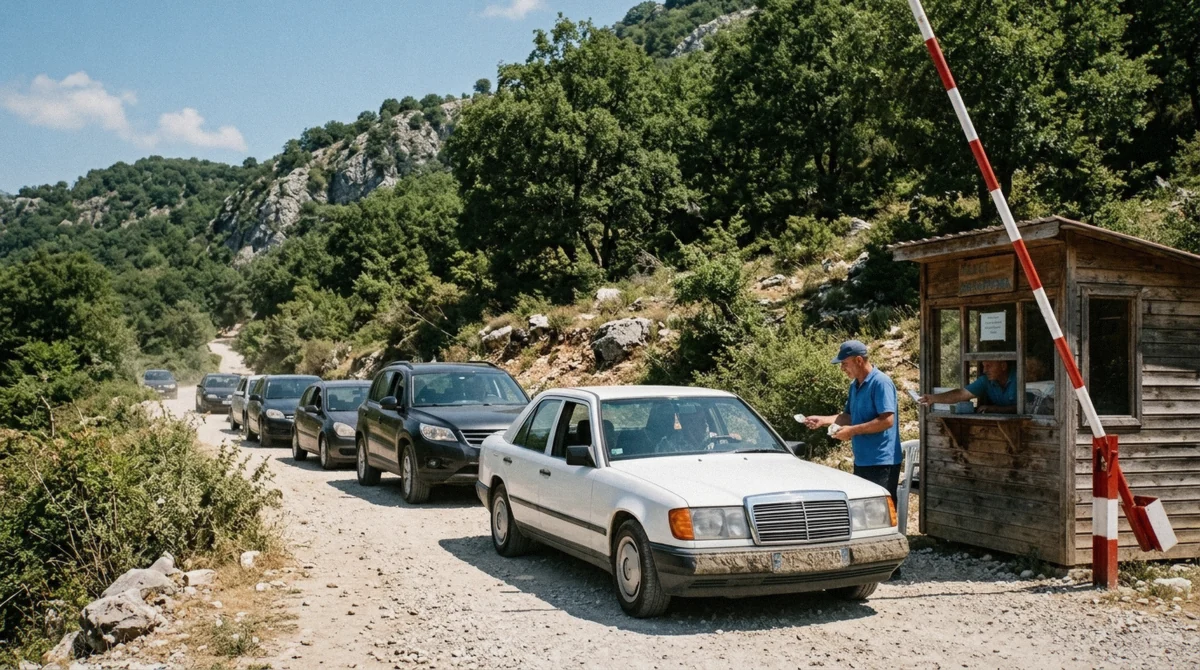
There are small free-parking spots near the ticket entrance, and it's worth knowing why most visitors avoid them: travellers reported a man posing as a policeman intimidating drivers who used those spots in summer 2024, including damage to at least one rental car. Use the main paid car park. The 300 lek buys you more than a parking space; it buys you the attended, official lot rather than an unofficial one.
Most visitors overestimate how long they'll actually stay. A first-time visit, walk in, platform, walk out, genuinely fits inside the 0-3 hour tier for the large majority of travelers, even accounting for the roughly 30-minute walk each way. Pay for the longer tier only if lunch at the on-site restaurant or a slower walk along the river is already part of your plan, since paying 400 or 600 lek up front for a visit that ends up running two hours is money left on the table at the cabin.
Cash Only, and Where the Nearest ATM Is
Everything at the site, the entry gate and the parking cabin alike, takes cash only, in lek or euros. There is no card terminal anywhere on site and no ATM in Muzinë itself. If you're relying on a card for the trip, you will be stuck at the barrier.
Euros are accepted, but at a rounded rate that favours whoever is collecting the fee, so lek works out cheaper if you're carrying both. The nearest ATMs sit back in Saranda or in Gjirokaster, so withdraw what you need before you set out rather than assuming you'll find one along the SH99.
This is a genuinely rural site well outside any banking network, not an oversight anyone is likely to fix soon. Treat the cash requirement the same way you'd treat a hiking trip with no resupply point: work out the total you need for entry, parking and any train or scooter rental, then add a margin for the restaurant or a souvenir, before you leave your accommodation that morning.
Opening Hours by Season
The site is open every day of the year, but the hours and what's actually running, the train, the restaurant, even the main car park itself, change sharply between summer and the rest of the year, so plan a shoulder-season or winter visit around the reduced schedule rather than the peak-summer hours you'll find quoted most often online.
| Season | Hours | Train running? | Restaurant open? |
|---|---|---|---|
| High summer (roughly June-August) | 08:00 to 20:00 | Yes | Yes |
| Shoulder months (April-May, September-October) | Roughly 07:00 to 19:00 | Yes, reduced schedule | Yes |
| Winter (roughly November-March) | Closes earlier as daylight fades; no official timetable | No, stopped October to March | Closed, along with shops and the main car park |
No official winter timetable is published anywhere, which means a late-afternoon visit between November and March is genuinely a gamble. If a winter trip is your plan, arrive well before midday to give yourself margin against an early close.
The practical effect of the winter closures goes beyond the shorter hours. With the train not running and the main car park shut, a winter visitor typically parks on whatever verge is available near the gate and walks the full distance to the spring both ways, in weather that can be genuinely cold at 10 to 13°C water temperature and low daytime highs down the valley in Saranda. None of that changes the entry fee itself, which stays 50 lek year-round regardless of season.
What the 50 Lek Actually Buys
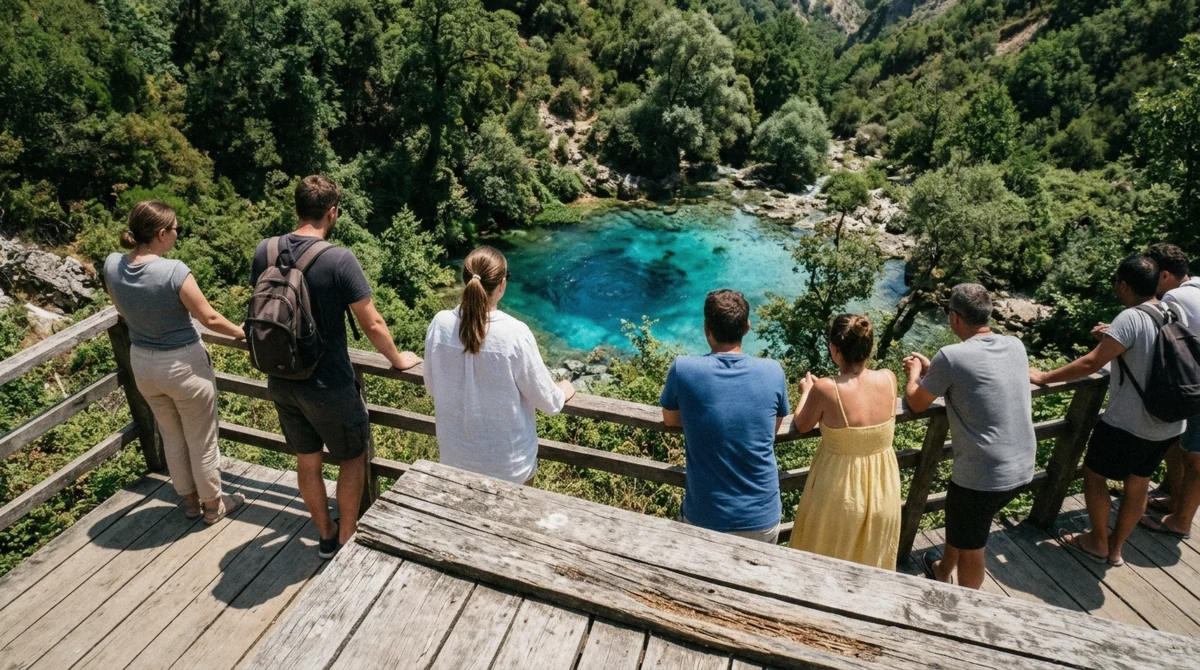
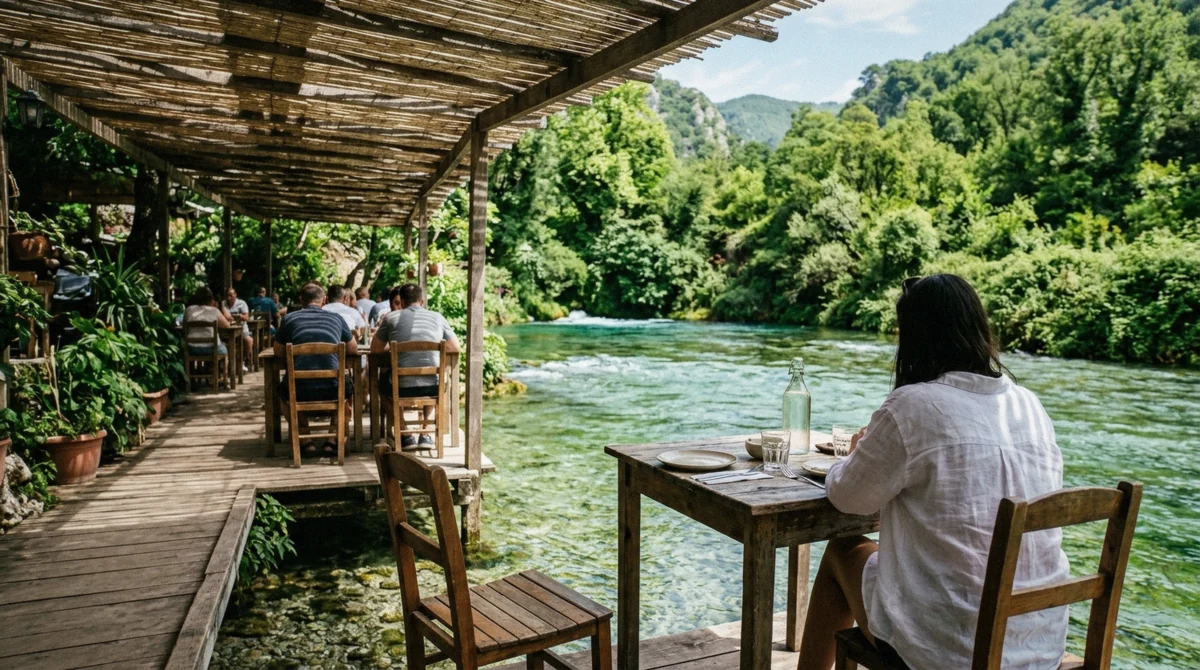
The entry fee gets you onto the site: the path in, the wooden viewing platform over the pool, and access to the river below where the outflow runs past the restaurant. That's the full list.
It does not buy swimming in the spring itself, which is fenced and enforced with a guard's whistle regardless of what you've paid. It does not buy a guided walkthrough; nobody meets you at the gate to explain what you're looking at, which is exactly the gap this site's guides exist to fill. And it does not buy the walk from the car park to the spring, since that distance is covered on foot, by train or by scooter no matter how much you've paid at the gate.
A reasonable way to think about the 50 lek is as an entry toll for a protected natural monument rather than a ticket to an attraction with amenities built for you. The café, the souvenir stalls and the cabins on site all charge separately for whatever you buy from them, and none of that is bundled into the gate fee in any form.
Budgeting the Whole Visit
Two worked examples, one self-driving and one on a tour, to put the fee table into real numbers.
| Scenario | What's paid | Rough total |
|---|---|---|
| Two people, own car, 2-hour visit | 100 lek entry (2 x 50) + 300 lek parking | About 4 EUR total |
| Two people, half-day tour at $20.76 each | $41.52 for both, plus 100 lek entry (2 x 50) collected at the barrier | About $42.50 all in |
The gap between those two totals is the price of not driving, parking, or figuring out the transport logistics yourself, covered in full on our how to get there guide. Neither number includes food at the site's restaurant, which most visitors skip in favour of bringing their own.
A third scenario worth budgeting for: a family of four arriving by car for a longer, three-to-four-hour visit that includes lunch and the river. That's 200 lek in entry (4 x 50) plus 400 lek in parking, about 6 EUR total before any food, which stays well under the price of even the cheapest single tour ticket. Anyone driving themselves and skipping the restaurant can genuinely see the Blue Eye for the cost of a coffee back home.
If You Come on a Tour
Booking a tour does not remove the gate fee. Entry is still collected in person at the barrier from every visitor, tour bus or private car, so carry small lek notes even if your transport, guide and everything else has already been paid for online. The most-booked half-day tour from Saranda includes the panoramic train one way, which is a separate cost from the 50 lek entry, not a substitute for it.
What a tour genuinely buys you, beyond transport, is not having to think about any of the fee mechanics on this page until you're standing at the gate with cash in hand. Guides on these tours generally know to remind the group about the entry fee before arrival, but it's still your own cash that changes hands at the barrier, not the tour operator's, so don't assume the reminder alone means it's been handled for you.
Frequently Asked Questions
Where do you buy tickets for the Blue Eye in Albania?
At the gate, in person, in cash. There is no advance ticket, no website selling entry, and no app for it. You pay 50 lek per person the moment you arrive.
Can you pay by card at the Blue Eye?
No. Both the entry gate and the parking cabin take cash only, in lek or euros. There is no card terminal on site and no ATM in Muzinë itself.
Is parking included in the entry fee?
No, they're charged separately. Entry is 50 lek per person; parking is a tiered fee on top, from 300 lek for up to three hours.
What happens if you only have large bills or a card at the gate?
You may not get in without a workaround, since neither the gate nor the parking cabin can process cards and change for large notes is not guaranteed. Bring small lek notes from Saranda or Gjirokaster before you set out.
Do children pay full price to enter the Blue Eye?
The 50 lek entry fee applies per person at the gate; the one documented exception is the panoramic train, where children ride free. No separate published child rate exists for the entry fee itself.
Why does the Blue Eye close early or shut some facilities in winter?
The restaurant, the shops and the main car park all close outside the summer season, and the tourist train stops running roughly October to March, since visitor numbers drop sharply and running full facilities year-round isn't worth it for the operators.
The whole ticket question resolves to one plain fact: there's nothing to book. Bring cash, expect to pay 50 lek at the gate plus parking by the hour, and treat any listing that promises a skip-the-line pass with suspicion, because none exists. Everything else on a Blue Eye day, the walk in, the platform, the river, comes free once you're through the gate. For the full picture of the site itself and every tour that runs there, see the Blue Eye Albania guide.
If you take one thing from this page into your trip, make it this: withdraw lek before you leave Saranda or Gjirokaster, not after. The fee stack here is small by any measure, a handful of euros for an entire visit, but small only helps you if you're actually carrying it in the right form when you reach the barrier.